Zolberg Institute: Conference On Migration, Displacement and Citizenship in an Urban World
30.11.21 - Now, more than ever, the city is the locus of human mobility. The majority of the world's migrants and forcibly displaced live in urban areas, and migration continues to be a fundamental process to the development and growth of cities. Samuel Hall co-founder Hervé Nicolle spoke at the Displacement and Citizenship in an Urban World Virtual Conference organised by the Cities and Human Mobility Research Collaborative, an initiative of the Zolberg Institute of Migration and Mobility at The New School.
Hervé spoke on a panel focused on Refugees and Cities, where he explored the response of Afghan urban neighbourhoods & cities globally to Afghan displacement, looking at how such spaces can become sites of refuge and protection"
Watch here
Read More
Migration & Refugees Research Network, Oxford Brookes University - Afghan Refugees Roundtable
02.11.21: Nassim Majidi, co-founder of Samuel Hall took part in the recent ‘Afghan Refugees’ roundtable, organised by the Migration And Refugees Research Network at Oxford Brookes University. The wide ranging discussion covered current challenges for displaced Afghans – both within and outside of the country.
Watch here.
Read More
Afghanistan, displacement and migration: what do recent events mean for future dynamics in the region?
29.09.2021 - The collapse of the Afghan government has brought displacement in Afghanistan into sharp focus. Samuel Hall co-founder Nassim Majidi joined this webinar, organised by the Graduate Institute Geneva’s Global Migration Centre, to critically examine what the Taliban’s recent takeover in Afghanistan means for migration and displacement in the country and the broader region.
The webinar was moderated by the Graduate Institute Geneva’s Prof. Vincent Chetail. Nassim was joined by Prof. Md Jalal Abbasi-Shavazi (University of Tehran), Dr Marie McAuliffe (IOM, Head of Migration Research Division), and Prof. Alessandro Monsutti (Graduate Institute Geneva).
Watch here.
Read More
EU-IOM - Monitoring the sustainable reintegration of child returnees: introducing a new practical tool
23.09.2021 - Marion Guillaume, Samuel Hall’s Children & Youth pillar lead, spoke at the launch event for the EU-IOM’s new monitoring toolkit, ‘Monitoring Toolkit and Good Practices for the Sustainable Reintegration of Child Returnees’. The toolkit, developed and field-tested by Samuel Hall in Ethiopia, Georgia, Honduras, Iraq and Nigeria, promotes a child-focused approach for both understanding and measuring the sustainable reintegration of child returnees in the economic, social and psychosocial dimensions. The Toolkit puts forth a set of practical tools that take into account the diverse experiences faced by child returnees across those dimensions.
Watch here.
Read More
Humanitarian Crisis in Afghanistan: How Could Europe Respond to Growing Displacement?
24.08.2021 - Samuel Hall co-founder Nassim Majidi, joining MPI's Hanne Beirens and UNHCR's Aurvasi Patel, spoke on this MPI webinar, organised in response to recent events in Afghanistan. Fleeing political instability and potential economic collapse, many thousands of Afghan civilians have began to, and will continue to, flee their homes and seek refuge, both internally and abroad. This conversation sought to explore Europe's possible responses to the situation in Afghanistan and neighbouring countries. Nassim outlined, amongst other points, the vital importance of granting Afghans Prima Facie refugee status, and the need for civil society, the private and public sectors to mobilise, make demands, and take action to protect Afghans.
Read More
Presentation - IGAD Conference 2021: Returnees' reintegration in rural areas
15.07.2021 - Speaking to the IGAD 2021 Conference, Nassim Majidi presented preliminary findings from a study, conducted by the Food and Agriculture Organization (FAO) and Samuel Hall, on the experiences of returnee reintegration in rural areas in Kenya, Afghanistan, Moldova, Nepal, Senegal, and Tunisia.
Read More
IOM Workshop - Drivers of Human Mobility across the Humanitarian, Development and Peace Nexus – Connecting Research with Policy and Programmes
28.06.2021 - This technical workshop, organised by the International Organisation for Migration (IOM), aimed to advance understanding on how to strengthen links between academic research and operational approaches to better identify, understand and address drivers of human mobility across the humanitarian, development, and peace nexus. Building on existing partnerships between IOM and academic institutions, the workshop facilitated the exchange of conceptual approaches to drivers of migration and displacement, available data sources and information gaps, and discussions on how the analysis and understanding of drivers can be integrated into broader, cross-cutting humanitarian and sustainable development assessments. The ultimate goal was to better inform policy and program interventions. Nassim presented key findings from Samuel Hall's February 2021 report, a collaboration with IOM and UNEP, on Identifying Climate Adaptive Solutions to Displacement in Somalia.
Read More
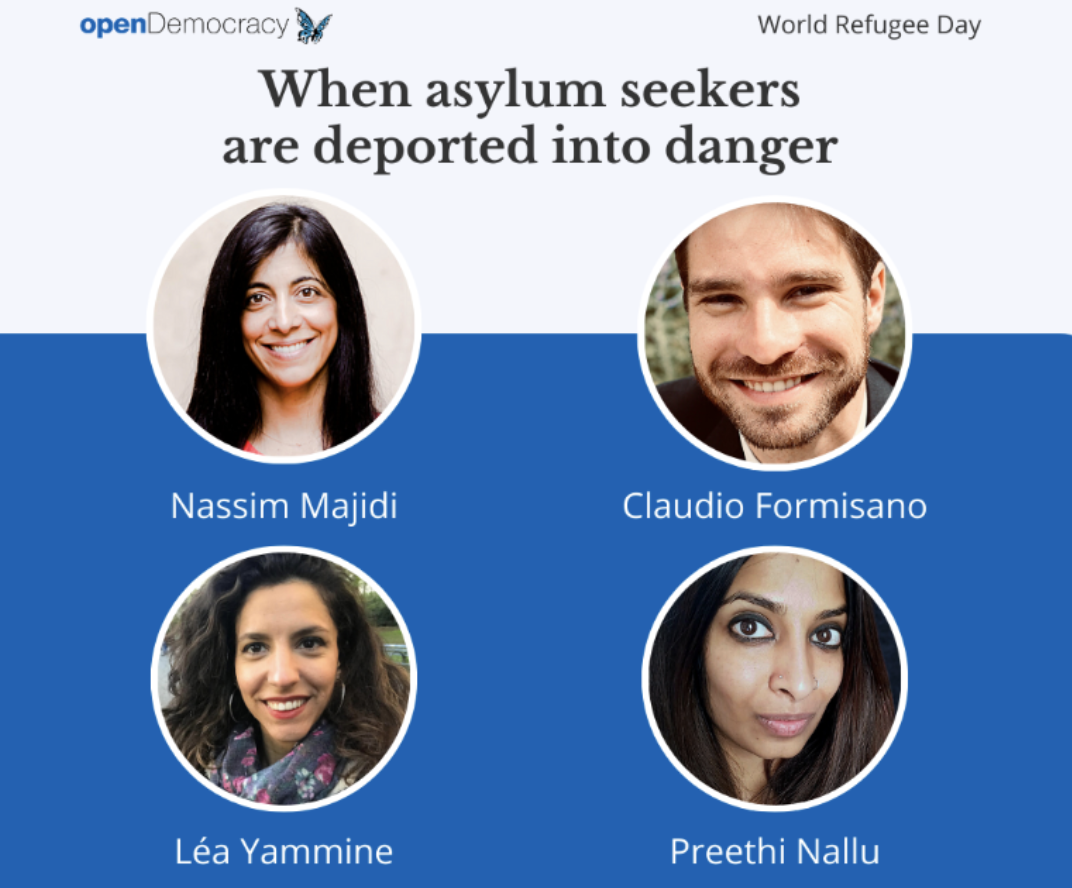
Open Democracy – When Asylum Seekers are Deported into Danger
24.06.21 - Most countries closed their borders over the pandemic, but for asylum seekers, deportation continued all over the world. More and more often, they are returned to the same life-threatening conditions that they fled. To mark World Refugee Day on 20 June 2021, and the launch of Open Democracy’s multimedia project 'Parallel Journeys', Samuel Hall co-founder joined a discussion chaired by Preethi Nallu on returns without reintegration. Her fellow panellists included Léa Yammine of Lebanon Support and international human trafficking expert Claudio Formisano.
Read More
Launch of the ILO Report "Digital Refugee Livelihoods and Decent Work - Towards inclusion in a fairer digital economy"
29.04.2021 - Jared Owuor, Samuel Hall’s Regional Operations Manager for East & Horn of Africa, presented Samuel Hall's contribution, under "Digital connectivity and entrepreneurship in refugee camps and settlements", to the ILO Report entitled "Digital refugee livelihoods and decent work". Samuel Hall provided a case study to the report titled "Digital access among refugees in East Africa: Implications for digital livelihoods provision". This was based on the project “Innovating Mobile Solutions for Refugees in East Africa: Opportunities and Barrier to Using Mobile Technology and the Internet in Kakuma Refugee Camp and Nakivale Refugee Settlement" (2018). Available at https://bit.ly/3hm2dEn
Read More
2021 Kenya Think Tanks Symposium (Panel Discussion): "Building Back Better" - The Role of Think Tanks in Supporting Recovery from COVID-19
15.04.2021 - The 2nd Kenya Think Tanks Symposium was held online. Organised by the Kenya Institute for Public Policy Research and Analysis (KIPPRA), the symposium brought together more than 50 Kenyan think tanks, officials and representatives from research and learning institutions. Jared Owuor, Samuel Hall's Regional Operations Manager for East & Horn of Africa, participated as a discussant in the Plenary Panel Session on "Adaptive Policy Research and Analysis in the COVID 19 era".
Read More
Refugee Self-Reliance Initiative: Research Exchange Call
14.04.2021 - The Refugee Self-Reliance Initiative (RSRI - https://www.refugeeselfreliance.org/) is a coalition of organisations, government agencies, foundations, research institutes, and other partners. Samuel Hall is a founding member. The Refugee Self-Reliance Initiative works on advancing self-reliance through three main pillars: programming, measurement, and advocacy. Regular learning calls with members of the community of practice. (implementers, academia, think tanks, donors...). On this call, Samuel Hall’s pillar lead for Data Standards & Analytics, presents her research looking at cash programming and Self-Reliance in Jordan followed by a discussion.
Read More
Presentation to the Foreign, Commonwealth & Development Office - Key Findings of the Comparative Analysis on Reintegration Outcomes
27.01.2021 - Nassim Majidi, Co-Director and Migration Pillar Lead and Joy Paone, IOM project manager, were invited to give a presentation on the results of the ‘Study on Reintegration Outcomes through a Comparative Analysis’ (ORION) for the Foreign, Commonwealth and Development Office. The presentation covered previous IOM -Samuel Hall collaborations such as: the ‘Setting Standards for an Integrated Approach to Reintegration’ under the MEASURE project which led to development of this current study. Moreover, the presentation covered the implications derived from the results obtained from the ORION study and key takeaways for policy makers and implementers.
Read More
Rabat Process Webinar: Voluntary Return and Reintegration
21.01.2021 - Nassim Majidi, Co-Director and Migration Pillar Lead was invited to moderate a webinar composed of key actors from European and African countries which make up the Rabat Process. The objective of the webinar was to identify lessons learned and best practices from each member state of the Rabat process, understand the implications and opportunities concerning the EU’s new Pact on Migration and Asylum and take stock of the effect of COVID-19 on return and reintegration and possible solutions.
Yaoundé, Cameroon
Read More
Migration Policy Institute- European Strategy on Voluntary Return and Reintegration: What Role for Origin Countries?
12.01.2021 - The Migration Policy Institute hosted a virtual workshop with key actors on return and reintegration to discuss the implications of the EU’s strategy on return and reintegration, as part of the new EU Pact on Migration and Asylum. Nassim Majidi, Co-Director and Migration Pillar Lead was invited to lead a discussion on the link between reintegration, development cooperation and local development. Nassim led a discussion which touched upon clarifying what development cooperation means, what are the gaps in current practice and what are the areas that need to be prioritized such as social protection for returned migrants and the enhancement of locally-led interventions.
Read More
OECD Report Launch: 'Sustainable Reintegration of Returning Migrants A Better Homecoming'
15.10.2020 - Nassim Majidi, Co-Director and Migration Pillar Lead was invited to be a panelist at the launch of the Organisation for Economic Cooperation and Development (OECD) report: 'Sustainable Reintegration of Returning Migrants: A Better Homecoming'. The multi-country peer reviewed project, conducted by the OECD in collaboration with German Corporation for International Cooperation (GIZ) examined the multi-valent factors that contribute to sustainable reintegration with the aim of improving programming, design, evaluation, and monitoring of reintegration initiatives. As a panelist Nassim highlighted the need for longitudinal evaluations, greater synergy between development cooperation and reintegration initiatives, greater reliance on local expertise and the pursuit of complementary solutions. In addition, Samuel Hall contributed two background papers concerning reintegration outcomes in Senegal and Afghanistan that fed into the OECD report.
Paris, France
Read More
Study on Reintegration Outcomes Through A Comparative Analysis: Results Presentation
07.10.2020 - Nassim Majidi, Co-Director and Migration Pillar lead, together with Camille Kasavan, Migration Pillar Project Manager presented the results of the ‘Study on Reintegration Outcomes through a Comparative Analysis. The study commissioned by IOM in the context of the ORION project funded by the UK Department for International Development, was conducted by Samuel Hall and the University of Sussex. The study aimed to assess how different factors can impact the reintegration of returning migrants, and to identify the most effective reintegration support practices in Guinea, Morocco and Senegal, with a specific focus on the mentoring approach piloted under the ORION Project. The Webinar is organized by the EU-IOM Knowledge Management Hub in partnership with Samuel Hall and the University of Sussex.
Geneva, Switzerland
Read More
The United Nations University - CRIS Dissemination Webinar: Reintegration in International Migration
12.11.2020 - Nassim Majidi, Co-Director and Migration Pillar Lead has been invited to present her research paper: ‘Assuming Reintegration, Experiencing Dislocation - Returns from Europe to Afghanistan’, which was selected to feature in the United Nations University- CRIS special issue journal ‘Reintegration in International Migration’. Nassim will present her paper among other selected authors to key stakeholders in a dissemination webinar organised by the United Nations University- CRIS. Nassim’s paper complicates the notion that existing social networks directly translates into positive reintegration outcomes. Taking the case study of returns from Europe to Afghanistan, Nassim provides a more nuanced view of the role of social networks in fostering the reintegration of returnees.
Brugge, Belgium
Read More
Return Migration and Implications for Policy and Practice: Global, Regional and National Multi-stakeholder Perspectives
15.09.2020 - Nassim Majidi, Co-Director and Migration Pillar Lead was invited to speak at the International Symposium on: ‘Return Migration and Implications for Policy and Practice: Global, Regional and National Multi-stakeholder Perspectives’. The Symposium was sponsored by IMISCOE as part of one of its Research Initiatives ‘Revisiting Return Migration in Shifting Geopolitics’. Nassim’s presentation concerned South-South return migration, particularly the double marginalisation that migrants face when they do not express a sense of belonging during their migration cycle or upon their return. Drawing on research conducted by Samuel Hall, Nassim presents the different ways in which the phenomenon of double marginalisation can occur among migrants and returnees in different contexts across different countries of the Global South such as: Senegal, Guinea, Afghanistan, Iran and Libya. Nassim rounds off her presentation by outlining the blind-spots in research and policy that arise if the phenomenon of double marginalisation is neglected, before concluding with recommendations researchers and policy makers can follow.
Lancashire, United Kingdom
Read More
Why and how should we research the deportation of foreigners? Epistemological, methodological and ethical issues in deportation studies
04.09.2020 - Nassim Majidi Co-Director and Migration Pillar lead was invited to give a presentation at a workshop convened by the University of Wolverhampton. The workshop brought together practitioners and scholars to discuss the genealogy of deportation studies and the epistemological, methodological and ethical challenges of deportation research. Building on the Samuel Hall report: ‘Coming Back to Afghanistan: Deported Minors’ Needs at a time of COVID 19’; Nassim stressed the importance of integrating demographics in research on deportation outcomes and advocated for the increased use of longitudinal studies in order to better understand the effects of deportation among affected groups.
London, United Kingdom
Read More
Techfugees: Kenya Re-Launch Webinar
24.06.2020 - Jared Owuor, Samuel Hall’s Regional Operations Officer, joined a panel discussion to celebrate the re-launch of Techfugees in Kenya. Samuel Hall is collaborating with Techfugees to boost their effort to gather data to measure the impact of coronavirus on refugee communities across the world. The objective for Techfugee’s global list of partners is to collectively build strong evidence-based advocacy that can inform policy-makers on best responses to protect displaced people. Watch the video here.
Nairobi, Kenya
Read More